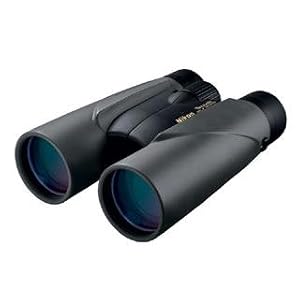
Here you're, If you want to buy Nikon 8221 Trailblazer 10 X 50mm All Terrain Binoculars, you comes at the right place. You can get special discount for Nikon 8221 Trailblazer 10 X 50mm All Terrain Binoculars.You can choose to buy a product and Nikon 8221 Trailblazer 10 X 50mm All Terrain Binoculars at the Best Price Online with Secure Transaction Here...

other Customer Rating:

List Price: $258.95
Price: $149.00 & this item ships for FREE with Super Saver Shipping. Details
You Save: $109.95 (42%)
read more Details
Nikon Trailblazer All Terrain Binoculars (ATB) are full-size roof prism binoculars that are right in the home or on any hunt. The Trailblazer features a slim, easy-to-carry design which has a full-size view to the budget-conscious consumer.
Nikon Trailblazer ATB Binoculars offer generous eye relief and turn-and-slide rubber eyecups allowing the binoculars being used as comfortably and effectively by eyeglass wearers as those with uncorrected vision. In addition, the Trailblazer binocular supplies a sizeable field-of-view at 1000 yards.
Nikon Trailblazer ATB Binoculars incorporates Nikon’s exclusive Eco-Glass (made devoid of the use of arsenic or lead) for lens and prism elements, also as multicoated lenses for max light transmission and image quality. Ergonomic styling, mated which has a rubber-armored exterior, the Nikon binocular provides added shock resistance along with a firm grip, wet or dry.
Nikon Trailblazer ATB Binoculars are fully waterproof and fogproof and so they are covered through the legendary Nikon ruggedness guarantee -25 Year Limited Warranty and No-Fault Repair/Replacement Policy.
Technical Specs
Focusing System – Center Focus
Magnification – 10x
Objective Diameter – 50mm
Angular FOV – Real – 5.6°
Angular FOV – Apparent – 52.1°
FOV @ 1000 yds – 293 ft
Close Focus Distance – 16.4 ft
Exit Pupil – 5mm
Relative Brightness – 25
Eye Relief – 19.6mm
Size (L&W) – 7.4 x 5.5
Weight – 29.1
Waterproof/Fogproof – Yes
Rugged Rubber Armor for Added Durability
Warranty Information
Nikon is dedicated to quality, performance and total customer satisfaction. If the Nikon binocular, Spotting Scope or Fieldscope requires service or repair not protected by our 25 Year Limited Warranty, Nikon will repair or change it (even it turned out your fault) just for $10, plus return shipping and handling.
Excludes – StabilEyes, Laser Rangefinders and Spotting Scope/Fieldscope eyepieces.
FAQ's
Real field of view
Real field of view may be the angle with the visible field, seen without moving the binoculars, measured from your central point with the objective lens. The larger the value is, the wider the viewfield available. For example, binoculars having a wider field of view are advantageous for locating fast-moving wild birds from the viewfield. And also this applies for finding small nebulas or perhaps a cluster of stars in astronomical observations.
Apparent field of view
Apparent field of view will be the angle of the magnified field if you look over binoculars.
The larger the apparent field of view is, the wider the concept of view you is capable of see even at high magnifications.
With the traditional method used previously, the apparent field of view was calculated by multiplying the actual field of view through the binocular magnification. (With this formula, apparent field of view wider than 65˚ is called wide field of view.)
After revision, Nikon's figures are now based around the ISO 14132-1:2002 standard, and obtained through the following formula:
tan ω' = τ x tan ω
Apparent field of view: 2ω'
Real field of view: 2ω
Magnification: τ
(With this formula, apparent field of view wider than 60° is named wide field of view.)
For example, the apparent field of take a peek at 8x binoculars with an 7.0°real field of view can be as follows:
2ω' = 2 x tan-1 (r x tan ω)
= 2 x tan-1 (8 x tan 3.5)
= 52.1°
Relative Brightness
Relative brightness value is obtained by squaring the diameter with the exit pupil. The greater the relative brightness is, the brighter the image will be. With 8x42 binoculars, the brightness is (42÷8)2= 28.1. What this means is when the magnification will be the same, the bigger the effective diameter with the objective lens, the brighter the look will be.
Do binoculars with the same exit pupil offer exactly the same brightness?
No. Brightness may vary even though the exit pupil is the same. This is because the amount of light reaching the viewer's eyes varies according for the quantity of lens elements superiority lens/prism coatings. Superior optical design and highquality coating greatly contribute towards the brightness of binoculars. Brightness values specified in product brochures, etc. are theoretical ones calculated inside the design process. Please note these factors when you compare actual brightness values.
Prism Coatings
Multilayer coating is also placed on prisms to raise transmittance. A roof prism system has one surface that doesn't feature total internal reflection, so vapor deposition with metals, etc. should be accustomed to enhance the reflectivity of the surface. Also, phase-correction coating on roof surface ensures high-contrast images.
*Binoculars' brightness and contrast are suffering from not only prism coatings, but additionally the quantity of objective lens and eyepiece lens, and kinds of coatings.
Metal-vaporized, high-reflectivity prism coating
Using vacuum-vaporization technology, metallic material such as aluminum or silver is applied to the reverse side of a prism surface that isn't totally reflective. This raises the reflectivity from the prism mirror surface.
Dielectric high-reflective multilayer prism coating
This coating features reflectance that exceeds 99%. By utilizing light interference, this coating assures high reflectivity across the full visible range, and ensures high color reproducibility.
Reflectance characteristics of prism coatings on mirror surface
The horizontal axis indicates the wavelength of light. The vertical axis indicates the reflectance of light.
Binoculars' brightness is determined not only through the reflective mirror, but in addition by the total optical system such as the amount of lenses and excellence of coatings.
Phase-correction coating
A roof (Dach) surface can cause phase shift of sunshine that affects image resolution. This phenomenon is due to phase differences arising from total light reflection on a roof (Dach) surface and yes it can occur with a good perfectly processed prism. Phase-correction coating is used for the surface to attenuate loss of resolution, ensuring high-contrast images.
Twilight Factor
The factor which includes the greatest impact on resolution or image detail, will likely be dependent upon the amount of light available during some time of observation. During daylight hours, when your skills pupil size will be no more than 2 to 3mm, magnification will likely be the principal factor in image resolution. At night, with all the eye pupil dilated to 6 to 8mm, aperture size may be the controlling factor. In twilight conditions both of those factors control resolution effectiveness and the twilight factor is the term that compares binocular performance under these conditions.
The twilight factor is calculated by using the square root from the product from the magnification and the aperture. The bigger the twilight factor, the higher the resolution from the binocular when observing under dim light conditions. For example, a 10 X 40 (twilight factor 20) would effectively resolve better under these conditions when when compared with a 7 X 35 (twilight factor 15.4) even though the 10 X 40 features a smaller exit pupil. Remember, however, the twilight factor does not take into consideration the transmittance or quality with the optical system.
Nikon Trailblazer 10x50 mm Binoculars... built for that toughest hunts! Dependability, thy name is "Trailblazer"! This ready-to-hunt pair has it all. Slim design, full-size view, water / fog / shock-proof toughness and a lot more! Have a closer look: Fully multi-coated lenses for great light-gathering ability with no glare; Turn and slide eyecups and 19.7 mm eye relief for more comfortable viewing; 100% water / fog / shock-proof; Ultra-rugged, rubber-armor; F.O.V.: 294' @1,000 yards; Exit pupil: 5 mm; Close focus: 16 1/2'; 10x magnification; Measures 7 1/2 x 5 1/2"; weigh 30 ozs. It is not hard to see... these are a few top-notch Binocs! Order yours now! Nikon Trailblazer 10x50 mm Binoculars
10x50mm, 19.7mm
294 ft @ 1000 yds

bestnightvision binocularsnight owl pro nexgen night vision Best Night Vision Binoculars

No comments:
Post a Comment